
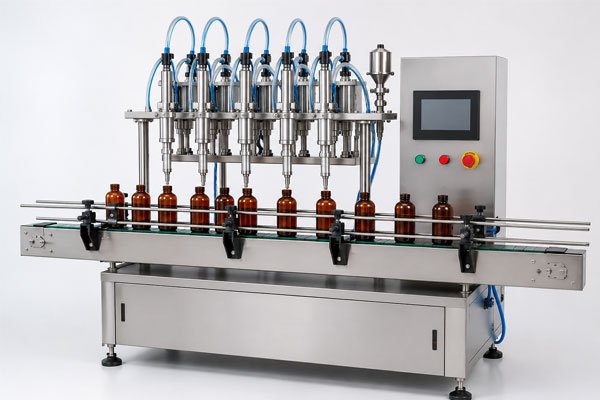
Modern manufacturing demands speed, consistency, and precision. Whether you’re filling edible oils, sauces, shampoos, detergents, creams, syrups, or pharmaceutical liquids, maintaining the exact fill quantity is essential for product quality and customer satisfaction.
An Automatic Piston Filling Machine has become one of the most reliable filling solutions for industries handling liquid and semi-liquid products. Designed for continuous production, these machines provide accurate filling volumes, reduce product wastage, improve productivity, and minimize human intervention.
In this guide, we’ll explore everything you need to know about Automatic Piston Filling Machines, from their working principle to their applications, benefits, and buying considerations.
What is an Automatic Piston Filling Machine?
An Automatic Piston Filling Machine is a fully automated filling system that uses a piston-cylinder mechanism to measure and dispense precise volumes of liquid or semi-liquid products into bottles, jars, cans, pouches, or containers.
Unlike manual or semi-automatic liquid filling systems, these machines perform filling automatically with the help of PLC controls, sensors, conveyors, and synchronized filling nozzles.
They are especially suitable for products with varying viscosities, ranging from thin liquids to highly viscous products.
How Does an Automatic Piston Filling Machine Work?
The filling process follows a simple yet highly accurate sequence:
Step 1: Product Intake
The piston retracts and draws a predetermined quantity of product from the storage tank into the cylinder.
Step 2: Container Positioning
Empty bottles or containers move automatically along the conveyor until they reach the filling station.
Step 3: Accurate Filling
The piston pushes the exact measured quantity through the filling nozzle into the container.
Step 4: Automatic Transfer
This entire process repeats continuously, ensuring consistent production with minimal variation.
Key Features of an Automatic Piston Filling Machine
High Filling Accuracy
The piston mechanism delivers highly precise filling volumes, reducing product giveaway and maintaining consistency.
Fully Automatic Operation
PLC controls and touchscreen interfaces simplify machine operation while reducing manual labor.
Multiple Filling Nozzles
Machines are available with multiple nozzles to significantly increase production speed.
Stainless Steel Construction
Food-grade SS304 or SS316 construction ensures hygiene, corrosion resistance, and long service life.
Adjustable Filling Volume
Operators can easily modify filling quantities without changing major machine components.
Anti-Drip Filling Nozzles
Special nozzles prevent dripping and maintain clean bottle surfaces.
Servo or Pneumatic Control
Depending on production requirements, machines can be equipped with servo-driven or pneumatic piston systems.
Easy Cleaning
Quick dismantling and CIP-compatible designs make cleaning simple and reduce downtime.
Advantages of an Automatic Piston Filling Machine
Exceptional Accuracy
Every container receives nearly identical product volume, reducing customer complaints and maintaining quality standards.
Higher Productivity
Automatic operation enables continuous production with minimal operator intervention.
Reduced Product Wastage
Accurate metering minimizes overfilling and product loss.
Low Maintenance
Modern machines are designed with durable components that require minimal maintenance.
Suitable for Various Products
A single machine can handle multiple liquid and semi-liquid products with proper adjustments.
Improved Hygiene
Stainless steel construction supports hygienic production environments.
Lower Labor Costs
Automation reduces dependency on manual filling operations.
Better Production Consistency
Every production batch maintains uniform filling quality.
Types of Products Filled
An Automatic Piston Filling Machine can efficiently fill:
- Thin liquids
- Medium viscosity liquids
- Thick liquids
- Semi-liquid products
- Paste
- Gel
- Cream
- Syrup
- Oil
- Grease
- Lotion
Industries That Use Automatic Piston Filling Machines
Many industries rely on these machines for efficient production, including:
- Food Processing
- Beverage Manufacturing
- Pharmaceutical Manufacturing
- Cosmetics
- Personal Care
- Chemical Processing
- Agrochemical Production
- Lubricant Manufacturing
- Dairy Industry
- Nutraceutical Industry
Automatic vs Semi-Automatic Piston Filling Machine
Feature | Automatic | Semi-Automatic |
Production Speed | Very High | Medium |
Operator Requirement | Minimal | Higher |
Accuracy | Excellent | Excellent |
Productivity | Continuous | Moderate |
Labor Cost | Low | Higher |
Automation Level | Fully Automatic | Partial |
Suitable For | Large Industries | Small & Medium Businesses |
Why Choose a Professional Automatic Piston Filling Machine Manufacturer?
A trusted manufacturer provides more than just equipment. They offer engineering expertise, customization, installation support, operator training, spare parts availability, and dependable after-sales service. Choosing an experienced supplier ensures your filling machine is tailored to your product characteristics, production capacity, and future expansion plans, helping you achieve reliable performance and a strong return on investment.
Conclusion
An Automatic Piston Filling Machine is one of the most efficient solutions for accurate, hygienic, and high-speed filling of liquid and semi-liquid products. From food and pharmaceuticals to cosmetics and chemicals, these machines help manufacturers improve productivity, reduce wastage, and maintain consistent product quality.
Investing in a well-designed Automatic Piston Filling Machine not only streamlines your production process but also supports long-term business growth through enhanced efficiency, lower operating costs, and dependable performance.
 Users Today : 4
 Users This Month : 187
 Total Users : 3021